A RETURN TO LOVE SUMMARY | KEY TAKEAWAYS FROM MARIANNE WILLIAMSON
There are books that change how you think. And there are books that change how you see. A Return to Love, published in 1992, belongs firmly in the second category. Marianne Williamson's debut book spent 39 weeks on the New York Times bestseller list, inspired a record-setting response when Williamson appeared on Oprah, and generated one of the most quoted and misattributed paragraphs in modern spiritual literature. Over three decades later, it continues to find new readers because its central question has never stopped being urgent: what would your life look like if you chose love instead of fear?
The answer Williamson offers is not soft or sentimental. It is, in its own way, the most demanding thing she could have written. Because she is not asking you to feel differently. She is asking you to think differently, and to do so in a world that is largely organized around the premise that fear is wisdom and love is naïve.
At its heart, A Return to Love is not really a book about spirituality. It is a book about the most fundamental choice any person makes every single day, and what becomes possible when you finally make it consciously.
The Book
A Return to Love is Williamson's accessible interpretation of A Course in Miracles, a 1,200-page spiritual text channeled by psychologist Helen Schucman in the 1970s. The Course, as it is commonly called, is dense, demanding, and unmistakably rooted in Christian metaphysics. Williamson spent years studying it before a friend suggested she write a book making its principles available to a wider audience.
What she produced is not a simplified summary. It is a deeply personal reckoning with the ideas, written in a voice that is direct, self-deprecating, and urgently contemporary. She draws on her own experience of depression, failed relationships, career struggles, and spiritual searching to illustrate concepts that could otherwise feel abstract. The result is a book that reads not like a lecture but like a conversation with someone who has been exactly where you are and found a way through.
The book is divided into two parts: Principles and Practice. The first establishes the theological and philosophical framework. The second applies it to relationships, work, health, and the nature of a meaningful life. But the scaffolding barely matters because the central argument is simple enough to fit on a single page, and radical enough to spend a lifetime with.
The Central Argument: Love and Fear
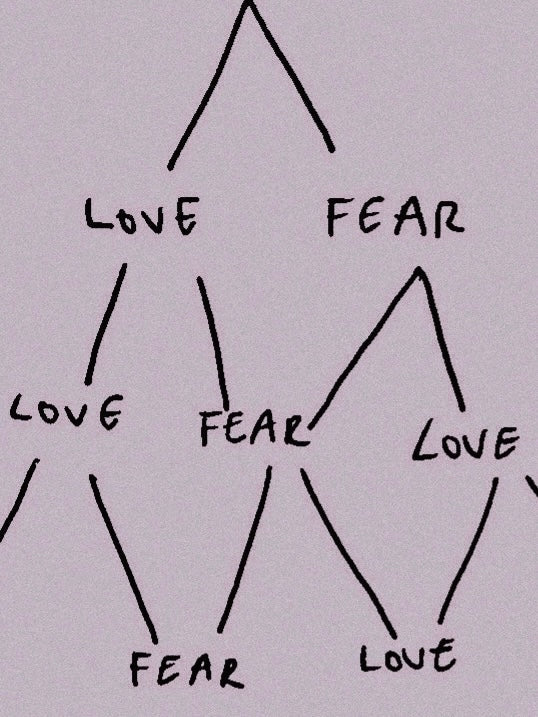
Williamson's framework begins with a distinction that A Course in Miracles makes explicit and that she spends the book exploring in every direction: there are only two emotions. Love and fear. Everything else is either an expression of one or a variation of the other.
Love, in Williamson's framework, is not a feeling reserved for romantic partners or family. It is the fundamental nature of reality. It is what we are made of beneath the ego's noise. It is the state the Course calls our natural inheritance, the ground of being to which we are always trying to return even when we cannot name what we are looking for.
Fear is the ego's primary language. And the ego, in Course terminology, is not the self but the false self. The constructed identity built from wounds, defenses, conditioning, and the belief that we are separate, insufficient, and fundamentally alone. The ego generates fear because fear keeps it necessary. A person who has returned fully to love has no use for the ego's protection. Which is exactly why the ego fights so hard.
What makes this framework so disorienting is that Williamson is not talking about obvious fear, the fear of failure, of rejection, of death. She is talking about the subtle, normalized fear that most people carry so constantly they have stopped recognizing it as fear at all. The chronic low-grade sense of not-enoughness. The armor worn in relationships. The ways people shrink or perform or hold back or strike first. All of it, she argues, is fear. And all of it can be answered with love.
What Miracles Actually Are
The word miracle is central to the book and central to A Course in Miracles, but not in the way most people expect. Williamson is explicit that miracles are not supernatural interventions or dramatic reversals of fortune. A miracle is a shift in perception. It is the moment when fear-based thinking is replaced with love-based thinking, and reality reorganizes itself accordingly.
This is a precise claim, not a vague one. When we perceive another person through the lens of fear, we see a threat, a disappointment, a source of pain, or a rival. When we shift that perception to love, we see a person who, like us, is doing the best they can from where they are, shaped by wounds they did not choose and carrying fears they may not yet have named. That shift does not change what happened. It changes what it means. And changing what it means changes what is possible.
Williamson calls people who cultivate this shift miracle workers. Not because they perform supernatural acts but because they have trained their perception to see through the ego's fear narratives to the love beneath them. And she argues that this training is both available to everyone and the most important work any person can undertake.
The Role of Surrender
One of the chapters that readers find most challenging and most transformative is the chapter on surrender. Williamson uses the term in the way A Course in Miracles uses it: not as defeat but as the release of the ego's control over outcomes, relationships, and the future.
The ego, she explains, is relentlessly invested in managing everything. It believes that if it can just control the situation, the relationship, the outcome, it can prevent the pain it fears. This strategy never works, because the ego's control strategies are themselves fear-based and therefore generate exactly the defensive, contracted quality of connection that produces more fear. The more tightly we grip, the more the relationship or the outcome resists.
Surrender, in Williamson's framework, is the recognition that there is an intelligence larger than the ego's management capacity, and that placing outcomes in the hands of that intelligence rather than our own fearful strategizing tends to produce better results than anything the ego could engineer. This is not passivity. It is the active practice of getting out of love's way.
Love in Relationships
The section on relationships is the one many readers find most personally confronting. Williamson's argument is that all relationships are spiritual assignments. We come together not to fill a void or find completion but to heal, and to be the instrument of healing for another.
The ego approaches relationships as transactions. It calculates what is being given and received, holds grievances, maintains ledgers of perceived slights, and withholds love as leverage or protection. This approach guarantees exactly the disconnection it fears.
The Course's approach, as Williamson describes it, is radically different. Relationships are opportunities to practice seeing beyond the ego, both your own and your partner's, to the love that underlies the fear. Forgiveness in this framework is not the generous act of excusing someone's behavior. It is the recognition that the behavior, whatever it was, arose from fear, as all ego-driven behavior does, and that the person beneath the behavior is, like you, someone who is trying to find their way back to love.
This does not mean accepting harmful behavior or remaining in relationships that damage you. Williamson is careful about this distinction. Loving someone does not mean allowing them to harm you. It means seeing them clearly enough to know what is actually happening, releasing the ego's need for the story to be different from what it is, and responding from love rather than retaliation.
The Deepest Fear
The passage from A Return to Love that has traveled furthest into the culture is not about relationships or forgiveness. It is about the nature of the fear that most people refuse to examine. It begins: our deepest fear is not that we are inadequate.
Williamson's argument is that most people assume their fundamental fear is of failure, of not being enough. But beneath that is a stranger and more paralyzing fear: the fear of being powerful, being radiant, being fully alive. Because full aliveness means full visibility, and full visibility means the possibility of real loss, real rejection, real consequence. Shrinking is safer. Playing small feels like protection.
But shrinking, she writes, does not serve the world. And the person who allows their light to diminish so that others will not feel threatened is not being humble. They are being afraid. The correction is not arrogance. It is the willingness to take up the space that love, rather than fear, dictates.
Work and Vocation
The chapter on work applies the same principles to career and creative life. Williamson argues that work becomes meaningful not when it pays the most or generates the most status but when it is understood as a vehicle for love's expression. The question she suggests asking is not what can I get from this but how can I use this to serve.
This reframe does not require anyone to abandon ambition or financial goals. It does require releasing the ego's grip on outcomes: the obsessive monitoring of whether things are going well enough, whether you are being recognized, whether you are ahead of where you are supposed to be. This grip, she argues, actually blocks the flow of the very creativity and generosity that would produce the outcomes being sought.
When work is understood as service, the energy around it changes. Williamson draws on her own experience of lecturing and writing to illustrate how differently creative and professional life flows when the underlying intention shifts from what can I gain to what can I give.
What A Return to Love Is Really About
Beneath the spiritual language, the Course references, and the framework of miracles and surrender, A Return to Love is a book about one thing: the decision to stop organizing your life around the assumption that you are fundamentally alone, fundamentally at risk, and fundamentally not enough.
That assumption is not the truth. It is a learned response to a world that teaches fear early and consistently. And like any learned response, it can be unlearned. Not through willpower or positive thinking, but through the patient, daily practice of choosing a different perception, of seeing what is happening through the lens of love rather than fear, and of trusting that the intelligence underlying everything is more capable of organizing a meaningful life than the ego's relentless, exhausting management.
This is the miracle Williamson is pointing toward. Not the dramatic intervention from outside. The quiet revolution from within.
The Key Themes
Love and Fear Are the Only Two Choices: Every thought, every response, every decision is either rooted in love or rooted in fear. This is not a comfortable idea. It is a clarifying one. Once you accept it, ambiguity about why you are doing what you are doing becomes much harder to sustain.
A Miracle Is a Shift in Perception: Miracles are not supernatural. They are the natural result of choosing to see through the ego's fear narrative to the love that underlies it. This shift is available in every moment and in every relationship.
The Ego Is Not the Enemy: Williamson does not demonize the ego. She understands it as a survival mechanism that served a purpose and outlasted its usefulness. The work is not to attack it but to stop believing everything it tells you.
Shrinking Does Not Serve Anyone: The fear of being too much, too visible, too powerful is as real and as limiting as the fear of being inadequate. Real love requires the courage to take up the space that love, rather than fear, dictates.
Relationships Are Assignments: Every significant relationship is an opportunity to practice choosing love over fear, to see through another person's fear to the love beneath it, and to be the kind of presence that makes it safe for them to do the same.
A Note on the Reader
A Return to Love is rooted in A Course in Miracles, which is in turn rooted in a Christian metaphysical framework. Readers who are not drawn to explicitly spiritual or theistic language may find certain sections require translation into their own terms. Williamson's framework holds up when the language is adjusted: replace God with love, replace miracle with perceptual shift, replace surrender with release of control. The underlying psychology is sound regardless of the theological frame.
The book is also unapologetically idealistic. Some readers will find this inspiring. Others will find it naive. The question worth sitting with is whether the idealism is actually naive or whether the cynicism that resists it is simply the ego's most sophisticated defense mechanism.
Final Thoughts
More than thirty years after its first publication, A Return to Love continues to find readers because the question it poses has not become less urgent. In a world that generates fear more efficiently than ever before, the invitation to choose love not as a sentiment but as a practice, not as a feeling but as a perception, remains one of the most quietly radical things a person can do.
Williamson did not invent this idea. But she made it accessible to a generation of people who needed it in a language they could actually hear.
The spiritual journey, she writes, is the unlearning of fear and the acceptance of love back into our hearts.
That is the whole of it. And it is enough for a lifetime.

BY Self Maximized