THE FOUNDATION: OUR SIX PILLARS OF HUMAN WELLBEING
Wellness has a noise problem.
It arrives in the form of biohacking protocols, supplement stacks, morning routines that require forty-five minutes and seventeen products, and an endless stream of content telling you that the reason you do not feel good is that you are not doing enough of the right things. The industry has made health feel complicated, expensive, and somehow perpetually out of reach. Something you are always almost achieving and never quite there.
We built Self Maximized because we do not believe it has to be that way.
Wellness, at its most essential, is not a trend. It is not a checklist. It is not a personality type or an aesthetic or a subscription. It is the ongoing, deeply human work of learning to take care of yourself in a way that actually fits your life. That work is not glamorous all the time. It is not linear. It does not look the same for everyone. But it is possible. And it is worth doing.
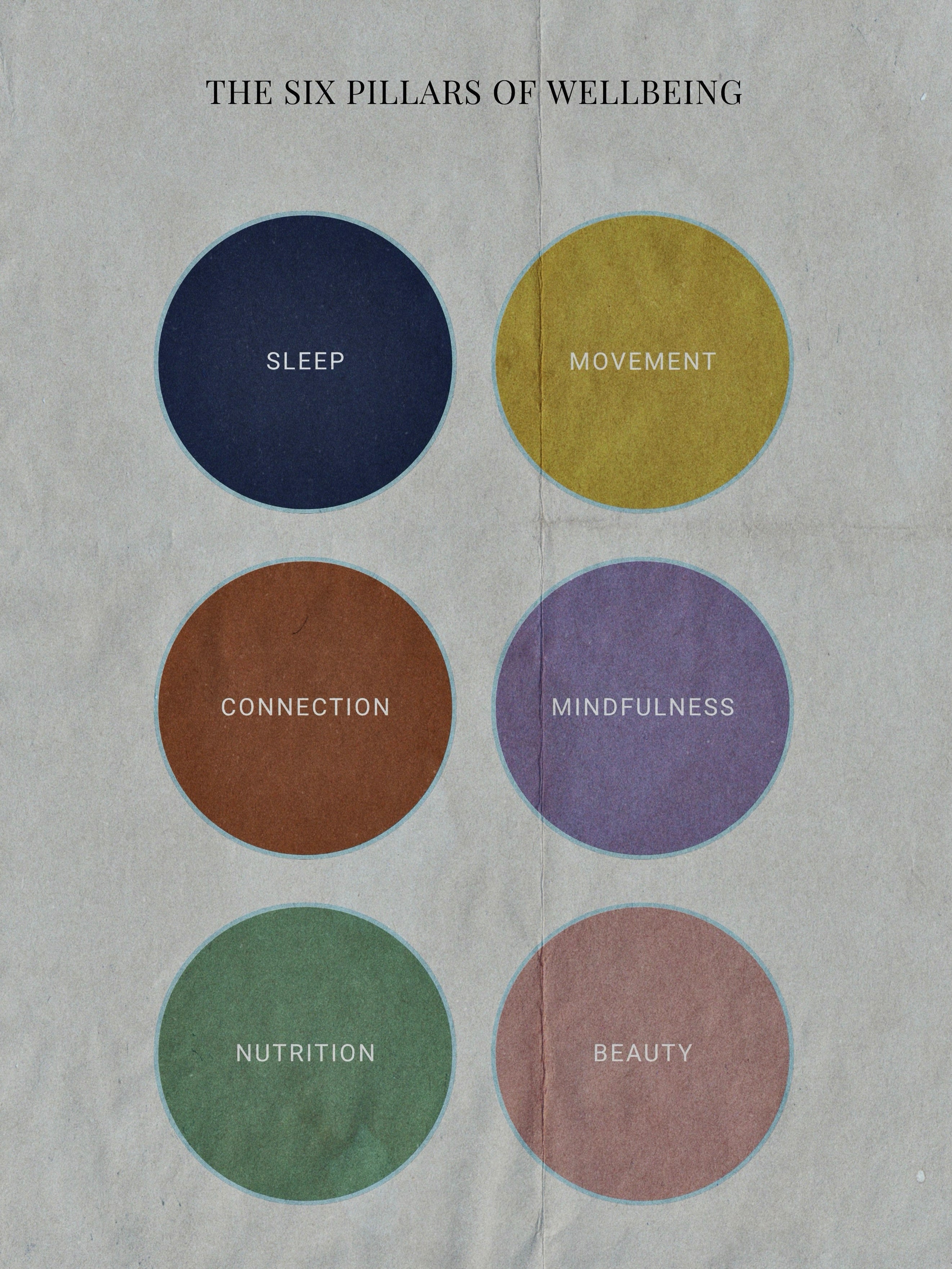
Everything we create at Self Maximized is grounded in six pillars of human wellbeing. Not because we invented them, but because the research keeps arriving at the same conclusions regardless of which direction it approaches from. These six areas, tended to consistently and understood as a whole rather than in isolation, represent the most evidence-backed, most human, most accessible foundation for a life that feels genuinely well.
Here is what each one is and why it is here.
01. Sleep
Sleep is not passive. It is the most active and the most foundational thing the body does.
During sleep, the brain clears metabolic waste through the glymphatic system, a biological cleaning process that does not operate at full capacity during waking hours. It consolidates memory, moving information from short-term to long-term storage. It regulates emotion, processes the experiences of the day, and restores every major system in the body from the immune system to the cardiovascular system to the hormonal environment that governs mood, appetite, fertility, and cognitive function.
Sleep deprivation does not simply make you tired. It makes you less able to think clearly, regulate emotion, resist illness, manage appetite, and perform at any level of your actual capacity. Research consistently shows that sleeping fewer than seven hours per night is associated with increased risk of cardiovascular disease, metabolic dysfunction, depression, and impaired immune response. Matthew Walker's foundational research on sleep has established that there is no major system in the body or process in the brain that is not measurably improved by adequate sleep and demonstrably impaired by its absence.
Sleep hygiene, the habits and environment that surround rest, matters as much as duration. Morning light exposure to anchor the circadian rhythm. Consistent sleep and wake times. A cool, dark room. Limiting artificial light and screen exposure in the evening hours. These are not small details. They are the architecture of recovery. And recovery, practiced nightly, is what makes everything else possible.
02. Connection
The Harvard Study of Adult Development is the longest running study of adult life ever conducted. It has followed the same group of men and their families for over 80 years across two generations of researchers and thousands of data points. Its conclusion, distilled by Robert Waldinger and Marc Schulz in their 2023 synthesis of the research, is both simple and staggering: the quality of our relationships is the single strongest predictor of health and happiness across a lifetime. Not wealth. Not intelligence. Not professional achievement. Relationships.
Connection is not a lifestyle preference or a personality trait. It is a biological need as fundamental as food and sleep. The research on loneliness and social isolation has consistently found that chronic disconnection is associated with elevated inflammatory markers, impaired immune function, disrupted sleep, increased cortisol, cardiovascular disease, accelerated cognitive decline, and mortality risk comparable to smoking fifteen cigarettes a day.
Connection at Self Maximized means more than human relationships, though those are at the center. It means connection with animals, whose calming presence measurably reduces cortisol and blood pressure. Connection with nature, which the research consistently shows restores the nervous system in ways that no built environment fully replicates. And connection with purpose, the sense of meaning and contribution that gives daily life its weight and its direction. All of it is connection. All of it matters biologically. None of it can be optimized alone.
03. Nutrition
Food is information.
Every meal sends signals to the brain, the gut, the immune system, and the hormonal environment that governs how you feel, think, age, and heal. The gut, containing approximately 100 million neurons and housing around 70 percent of the immune system, is in continuous conversation with the brain through the gut-brain axis. What you eat shapes the microbiome that mediates that conversation. It influences serotonin production, inflammatory response, hormonal regulation, and the quality of sleep and mood that follows.
Michael Pollan's foundational work on food and culture established something the research has continued to confirm: the closer food is to its whole, unprocessed form, the more the body recognizes it and the more effectively it can use it. Ultra-processed foods, which now make up the majority of calories consumed in Western diets, are associated with systemic inflammation, gut dysbiosis, metabolic dysfunction, and accelerating rates of chronic disease.
But at Self Maximized, nutrition extends beyond what we eat. It includes everything the body absorbs. What we put on our skin, which enters the bloodstream through the body's largest organ. The air we breathe, which carries particulate matter, pollutants, and volatile compounds that accumulate in tissue over time. The chemicals in our environment, including the endocrine-disrupting compounds in plastics, personal care products, non-stick cookware, and food packaging that interfere with hormonal signaling in measurable and documented ways. Philip Landrigan's research on environmental chemical exposures has established that the toxic burden of modern living is a genuine and underacknowledged contributor to chronic illness.
What we consume and what we avoid are equally part of this pillar. The body does not distinguish between a dietary input and an environmental one. It simply responds to what arrives.
04. Movement
The body was not designed for stillness. For most of human evolutionary history, sustained movement was not a lifestyle choice. It was the condition of existence. And the biological systems that govern mood, cognition, metabolism, cardiovascular health, and longevity co-evolved within that context of continuous physical engagement.
John Ratey's research on exercise and the brain, published in his landmark work on the subject, established the neurological mechanisms through which movement restructures the brain. Regular physical activity increases BDNF, brain-derived neurotrophic factor, the protein that supports the growth, survival, and communication of neurons. It stimulates neuroplasticity. It regulates mood through the same neurochemical pathways targeted by antidepressants. It improves insulin sensitivity, reduces systemic inflammation, supports cardiovascular function, and is among the most evidence-backed interventions available for both longevity and mental health.
Research in lifestyle medicine consistently identifies physical inactivity as one of the most significant modifiable risk factors for chronic disease, second only to smoking in some analyses. The dose required for meaningful benefit is lower than the fitness industry typically suggests. Thirty minutes of moderate movement most days is sufficient to produce measurable health benefits. The most important step is simply the transition from sedentary to moving, not from moderate to intense.
Movement is medicine. Not metaphorically. Mechanically.
05. Mindfulness
The capacity to be present is one of the most powerful tools available to the human nervous system. And it is one of the most systematically eroded by the conditions of modern life.
Jon Kabat-Zinn's development of mindfulness-based stress reduction in the 1990s gave the research community a replicable methodology for studying what contemplative traditions had practiced for thousands of years. What the subsequent decades of research have found is consistent and compelling. Mindfulness practice reduces cortisol and systemic inflammation. It improves emotional regulation by strengthening the prefrontal cortex's capacity to modulate the amygdala's threat response. It enhances immune function, improves sleep quality, reduces symptoms of anxiety and depression, and creates the neurological conditions for clarity, creativity, and calm.
Mindfulness at Self Maximized is not a specific meditation technique or a commitment to thirty minutes of silent sitting. It is the broader practice of cultivating present-moment awareness in whatever form that takes in a given life. Eating without a screen. Walking without headphones. Noticing the breath before a difficult conversation. Pausing before reacting. The research supports all of it. The nervous system responds to presence regardless of the form through which it is practiced.
The evidence for mindfulness as a genuine health intervention, rather than a wellness accessory, is now substantial enough that it appears in clinical guidelines for chronic pain, anxiety, depression, and cardiovascular disease management. This is not a soft recommendation. It is science.
06. Beauty
This is the pillar that surprises people most. And it is the one we feel most strongly about including.
Beauty is not vanity. It is not surface. It is not an indulgence that belongs at the bottom of a wellness hierarchy after the serious things have been attended to. It is, according to a growing body of research in environmental psychology, neuroaesthetics, and psychoneuroimmunology, a genuine biological input that shapes how safe, alive, and at home we feel in our own lives.
Roger Ulrich's landmark 1984 study found that surgical patients whose hospital room windows overlooked trees recovered faster, needed less pain medication, and had shorter hospital stays than patients whose windows faced a brick wall. The view of natural beauty was not incidental to recovery. It was contributing to it. The research that has followed in the four decades since has confirmed what that study suggested: the aesthetic quality of our environments is not neutral. It communicates with the nervous system continuously, influencing cortisol, blood pressure, immune activity, and emotional state in ways that are measurable and meaningful.
The environments we inhabit, the rituals we practice, the care we bring to how we live and how we present ourselves, all of it sends signals. To the nervous system. To the sense of self. To the capacity for joy, pleasure, and the particular aliveness that comes from being genuinely present to the beauty that exists in ordinary life.
At Self Maximized, beauty is not about perfection or performance. It is about the practice of creating the conditions in which you feel well, at home, and cared for by your own life. That practice is part of wellness. It always has been.
Why Six Pillars, Not One
The most important thing about these six pillars is not any one of them. It is the way they speak to each other.
Poor sleep elevates cortisol, which disrupts nutrition choices, which impairs gut function, which reduces serotonin, which darkens mood, which erodes the motivation to move, which compounds the disconnection from other people, which accelerates the biological aging that poor sleep was already driving. The pillars do not exist in isolation. They are a system. And the system runs better when all of its parts are attended to.
Research published in the American College of Lifestyle Medicine's framework has established that lifestyle behaviors influence each other in ways that make their combined effect significantly greater than their individual contributions. Sleep and exercise together produce outcomes neither produces alone. Connection and mindfulness together create a nervous system resilience that either in isolation cannot fully generate. The whole, tended to with intention and gentleness and the understanding that nothing needs to be perfect for progress to be real, is what produces the quality of life that all the individual interventions are reaching for.
This is what we are building at Self Maximized. Not a wellness brand that sells you the next thing. A media brand that takes the research seriously, translates it honestly, and trusts you to know what to do with it.
Everything we create is grounded in our six pillars of human wellbeing. We believe they are the foundation of a fully human life.
Welcome.
Scientific Sources
- Walker, M. Why We Sleep: Unlocking the Power of Sleep and Dreams. Scribner, 2017.
- Huberman, A. Huberman Lab Podcast: Sleep, Light, and Circadian Rhythm. 2021.
- Waldinger, R. and Schulz, M. The Good Life: Lessons from the World's Longest Scientific Study of Happiness. Simon and Schuster, 2023.
- Pollan, M. In Defense of Food: An Eater's Manifesto. Penguin Press, 2008.
- Landrigan, P.J., et al. Pollution and Global Health: An Agenda for Prevention. Environmental Health Perspectives, 2018.
- Ratey, J. Spark: The Revolutionary New Science of Exercise and the Brain. Little Brown, 2008.
- Kabat-Zinn, J. Wherever You Go, There You Are: Mindfulness Meditation in Everyday Life. Hyperion, 1994.
- Ulrich, R.S. View Through a Window May Influence Recovery from Surgery. Science, 1984.
- PMC. The Power and Connection of the Six Pillars. American Journal of Lifestyle Medicine, 2023.
- Forward Family Medicine. The Six Pillars of Lifestyle Medicine Explained. forwardfamilymedicine.com, 2026.

BY Self Maximized